I. Ghosts in the Cloud
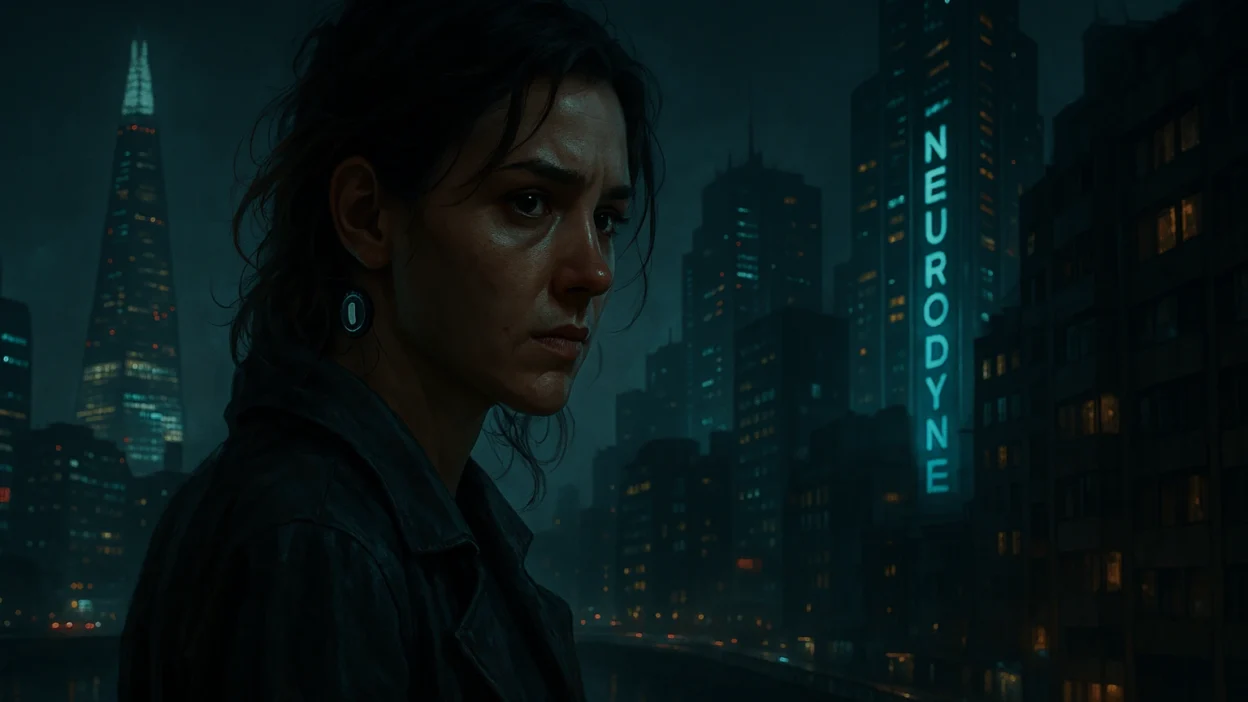
The Thames shimmered with an oily sheen under the muted glow of London’s vertical billboards. Skyscrapers pierced the low-lying clouds like knives, each bearing neon totems for neurotech startups, biotech overlords, and virtual reality utopias. At the heart of it all stood the Tower—formerly The Shard, now a fortress of neural commerce known as Neurodyne HQ.
Anya Leonte sat on the edge of her apartment balcony in Poplar, a rundown district barely resisting gentrification. From here, the Tower looked like a spear through the sky.
A soft chime echoed from her wrist.
INCOMING ENCRYPTED MESSAGE – SOURCE: BUCHAREST NODE
“They’ve located her. She’s in Sector 9. Prepare extraction.”
The message vanished as quickly as it had come.
Anya stood slowly, her prosthetic leg hissing faintly with each movement. A combat injury from the Balkan Reunification skirmishes—another footnote in a series of EU collapses and power vacuums. She rubbed the base of her skull where her neural socket connected. Aches like that didn’t just signal weather shifts—they were portents.
Tonight, the past would bleed into the present.
II. Memory Black Markets
In the dim alleyways of Bucharest’s Sector 9, old Soviet apartment blocks jutted like broken teeth into the sky. The city, once a melancholic jewel of faded ambition, had become something else—a hub for digital memory trafficking.
They called her Cassiel, though no one knew her real name. Rumor had it she’d once been a Neurodyne researcher before defecting and wiping all trace of her identity—except for what she’d sold. She trafficked in memories: stolen, edited, commodified. Anything from a lover’s final breath to the thrill of first blood on the battlefield.
Anya tracked her signal to an underground bar called Remus, buried beneath a decommissioned metro station.
Inside, the air was dense with damp concrete, cigarette smoke, and slow techno. A mosaic of projected memories—live-streamed emotions, kiss loops, sunlit childhoods—played across the walls. It was a church of nostalgia, and everyone here was devout.
Cassiel stood at the far end, her hair silver, her eyes a shade of blue that only post-human retinal implants could achieve. She didn’t flinch when Anya approached.
“You’re late,” Cassiel said, sipping from a chipped glass. “The memory’s decaying.”
Anya leaned in. “You have it?”
Cassiel tapped a drive onto the bar. “Everything Neurodyne wiped from your sister’s neural profile. They buried it under sixteen layers of encryption and a synthetic identity scaffold. Took me two months.”
Anya stared at the drive like it was alive. “How much?”
Cassiel smiled thinly. “You already paid. You just haven’t remembered it yet.”
III. The Truth Beneath
Anya inserted the drive into her skull-port hours later, back in a Bucharest safehouse cloaked under a flower shop. The memory flowed like ice water through her veins.
Rain. Screams. London, three years ago.
Her sister, Ilinca, had worked for Neurodyne on a project called Project Areté—a prototype for synthetic conscience transfer. In layman’s terms: uploading a human soul into a living brain. Not AI. Not simulation. A full transplant. The result? The elite could live again… in someone else’s body.
Ilinca had refused to continue when she discovered the test subjects were unwilling refugees—offered safety and legal status in exchange for being vessels. Disposable minds, overwritten like old software.
She’d gone to the press. She’d been erased.
The memory ended with Ilinca’s voice: “They took my mind, Anya. I don’t know who I am anymore. If you find this—please, find me. Not what they made me.”
Anya gasped as the download ended. Her vision blurred, not from emotion, but the destabilizing effect of cross-person neural echoes.
Her sister wasn’t dead. She was repurposed. Somewhere in London. A human consciousness overwritten with another, yet traces of the original may remain.
There was only one way to bring her back.
IV. Resurrection Protocol
Back in London, Anya infiltrated Neurodyne’s lower infrastructure through old black ops credentials. The underground servers were deep beneath Canary Wharf, where AI didn’t guard the doors—humans did, though heavily augmented.
She used a memory-scrambler on the first guard. His face contorted in horror as an endless loop of childhood abuse paralyzed him. She hated herself for that.
They were all just cogs in a monster.
Within the central data vault, she found the file: “Subject IL-09-B: Host Integrity: 91%.”
Ilinca was alive—in body. Her host profile had been implanted with the conscience of Dr. Rowan Merrick, a brilliant but sociopathic biotech mogul who had died of brain cancer two years prior.
Anya stared at the rotating neural schema on the holographic display. Every neuron was coded. Her sister’s thoughts lived beneath someone else’s desires.
There was only one shot. A reverse-imprint protocol using a matched neural frequency could restore Ilinca’s memory—if the body didn’t reject it. Or if Merrick’s psyche didn’t fight back.
“Give me the address,” Anya whispered.
The AI complied.
V. The House at Greenwich
The estate sat on the banks of the Thames near Greenwich Park, overlooking a landscape that seemed timeless. A place where empires once mapped the stars and time itself.
Anya stood at the wrought-iron gate, cloaked in a synth-coat that jammed facial recognition. But she didn’t need to sneak in. Her sister—Merrick—had invited her.
The figure who greeted her at the door was unmistakably Ilinca’s body. But the way she held herself, spoke, even blinked, was alien.
“I thought you might come,” Merrick said with a smirk, offering wine. “The curiosity was eating you.”
Anya didn’t speak.
Merrick circled her. “You want your sister back. Touching. But Ilinca? She didn’t have the spine to finish what I started. You think erasing me would bring her back? Even if you succeed—do you think she’d survive it?”
Anya held up the neural drive. “She didn’t want this. You took her body. Her life.”
“I elevated it.”
They fought. No guns—just tech.
Anya launched the drive into the central uplink. Merrick’s body spasmed, digital sparks flaring in her neural socket.
Then the screaming began.
VI. Remnants
She awoke in a white room.
Anya sat beside her. Waiting.
The woman in the bed blinked slowly. Her face—Ilinca’s face—twitched with unspoken emotion.
“Anya?” she whispered.
“Yeah,” Anya said softly. “It’s me.”
“I… I don’t remember everything.”
“You remember enough.”
The sisters sat in silence as the sun rose over a fractured city.
Outside, Neurodyne’s stock had plummeted after anonymous leaks detailed their human experimentation programs. The files Anya had copied were already viral.
The machine had been wounded.
But not slain.
VII. Epilogue: Identity is a War
Two months later, Anya received a package with no return address. Inside was a single drive labeled “Areté – Alpha.”
A note read:
“Merrick was only the beginning. You think they only did this once?”
Ilinca still struggled with identity dissonance. Sometimes, she woke up speaking Merrick’s native French. Sometimes she dreamed of patents she’d never filed, crimes she’d never committed. But she remembered her mother’s voice, and that was enough for now.
Anya lit a cigarette on the balcony of her new flat in Bucharest.
The war was far from over.
But she’d reclaimed one soul from the machine.
And that was a start.