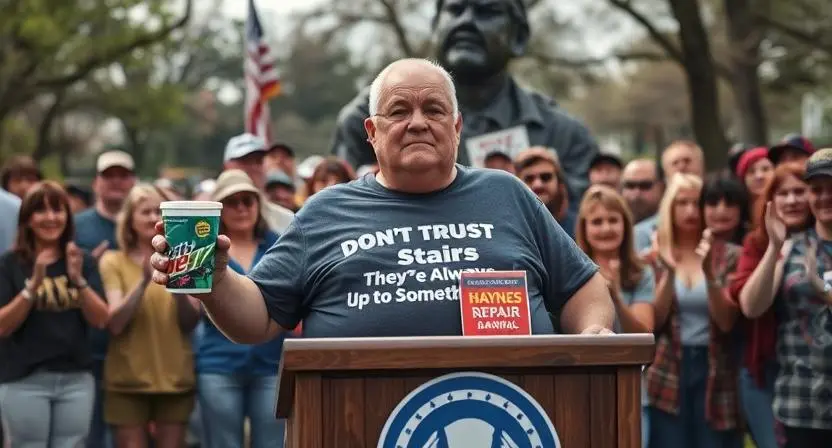
Earl “Meatball” Jenkins hadn’t set out to become mayor of Topeka, Kansas. In fact, he had spent the better part of his 58 years trying to avoid any responsibility greater than remembering his Netflix password. A retired mechanic with a gut shaped like a deflated basketball and an attitude permanently lodged somewhere between “grumpy” and “apocalyptically unimpressed,” Earl spent most of his days drinking gas station coffee and giving unsolicited advice to squirrels in Gage Park.
Everything changed the day someone mistakenly put his name on the mayoral ballot.
It was meant to be Earl Jenkins Jr., a local college kid studying political science who had ambitious dreams of fixing Topeka’s decaying infrastructure and implementing progressive zoning laws. But a clerk at City Hall—blinded by a migraine and years of bureaucratic apathy—entered the wrong Social Security number. Earl Sr. was now a candidate.
And then… he won.
By a landslide.
The whole city had assumed “Meatball” was a satirical write-in candidate, a local legend of sorts after going viral for ranting about potholes on TikTok while wearing a “Don’t Trust Stairs, They’re Always Up to Something” T-shirt. Voters, fed up with polished politicians, checked the box in droves. It was the 2020s. Stranger things had happened—like the raccoon that briefly became mayor of a small town in Oregon.
CHAPTER 1: THE INAUGURATION AND THE VAPE-ADDLED LOYAL OPPOSITION
“I do solemnly swear,” Earl slurred, holding up one hand while balancing a Styrofoam cup of Mountain Dew in the other, “to do my best not to screw things up too badly.”
There was no Bible. Instead, he placed his hand on a 1986 Haynes Repair Manual for the Chevy Nova.
The crowd cheered.
Across the park, hidden beneath a tent sponsored by a boutique vape brand, stood Topeka’s political opposition: The Progressive Libertarian Vape Caucus. Their leader, Indigo Rayne (formerly known as Dale), glared through tinted sunglasses, puffing clouds of artificially blueberry-flavored smoke.
“He’s a pawn of Big Muffler,” Indigo sneered.
“Are you high?” asked Sasha, his deputy. “He once tried to sue a drive-thru speaker for emotional distress.”
Indigo just exhaled a perfect smoke ring in the shape of a question mark.
CHAPTER 2: EARL FOR PRESIDENT?
Topeka didn’t expect much from Mayor Meatball. Which is why, when potholes started disappearing, city hall paperwork got digitized, and local businesses reported their best quarter in a decade, people began whispering.
It wasn’t that Earl had some grand political genius. He just didn’t care about re-election. So when the city council tried to block his plan to turn abandoned strip malls into community centers with libraries and hot dog carts, he called their bluff.
“Fine,” he said. “I’ll leak all your browser histories on Reddit.”
Silence.
Motion passed.
By month six, the national media came sniffing around. NPR did a profile called “From Grease to Governance: The Earl Jenkins Phenomenon.” A Twitter thread comparing his leadership style to that of an “American Genghis Khan with IBS” went viral. People in Portland and Austin started wearing knockoff Meatball campaign shirts that read, “Fix Sh*t, Not Feelings.”
It was only a matter of time before the idea emerged.
Earl should run for President.
He found the idea as ludicrous as everyone else—until the Koch brothers accidentally donated $2 million after a clerical mix-up. Earl, never one to waste a windfall, used it to charter a tour bus, hire a campaign manager named Deb who used to sell pharmaceuticals on Instagram, and begin what would come to be known as the Grease and Grits Tour.
CHAPTER 3: THE MORAL DILEMMA OF A WENDY’S IN CEDAR RAPIDS
Earl’s campaign reached a fever pitch in Iowa.
During a televised town hall in Cedar Rapids, he was asked about climate change.
“Well,” Earl said, scratching his chest with a butter knife, “I believe in it. I also believe it’s rude to fart on an airplane. Doesn’t mean people stop doin’ it.”
The crowd exploded in applause.
But not everyone was amused.
Indigo Rayne, who had tracked the campaign to Iowa, staged a protest at a local Wendy’s. They chained themselves to the drive-thru speaker and declared the “Meatball Era” a farce.
Earl, being Earl, pulled into the Wendy’s in his 1992 Buick LeSabre, ordered a Frosty, and confronted them.
“You ever actually run a city?” he asked.
“No,” Indigo said, voice muffled by a tactical balaclava. “But I believe in radical transformation through collectivist reclamation of post-capitalist structures.”
Earl blinked.
“Cool. But can you patch a radiator with a tampon and a bottle of Coke?”
“…No.”
“Then shut up.”
He slurped his Frosty and left.
CHAPTER 4: THE MEATBALL DOCTRINE
By the time Earl reached Pennsylvania, his policies had developed something resembling coherence:
- Mandatory community barbecues every quarter.
- Universal healthcare for pets.
- Free mental health hotlines staffed by ex-therapists and retired bartenders.
- A national “Leave Me Alone” day every February 29th, during which all forms of communication except emergency services were disabled.
Pundits were baffled. Voters were intrigued. Earl was exhausted.
It was during a debate in Scranton, across from a woman who had once run a think tank for AI ethics in D.C., that Earl finally broke.
“Listen,” he said, gripping the podium like it was a lifeboat in a sea of nonsense, “I ain’t here to sell you a fantasy. I ain’t even sure I wanna be here at all. But if you put me in that office, I promise three things:
One—no bull. Two—no consultants. And three—I will personally beat up any lobbyist who brings me gluten-free cupcakes.”
The moderator didn’t know whether to cut to commercial or cry.
CHAPTER 5: TOPEKA, AGAIN
He didn’t win the presidency.
In the end, America wasn’t ready for the Meatball Doctrine. The final electoral map showed he’d carried Kansas, most of Missouri, two counties in Nevada, and inexplicably, Brooklyn.
Earl returned to Topeka with no fanfare.
He walked into his favorite diner, Tina’s All-Day Breakfast, and sat at the counter like nothing had happened.
“You want the usual?” asked Tina.
“Yeah,” he sighed. “Add a side of failure.”
“Comin’ right up.”
As he stared into his coffee, a young city planner approached. Nervous. Hopeful.
“Mayor Jenkins,” she said. “We’re starting a program to get more community input into urban design. Think you’d want to be part of it?”
Earl looked up. Outside, the streetlamp flickered over a pothole-free road. The city was quieter now, but not asleep. Just… catching its breath.
He sipped his coffee.
“Sure. Just don’t ask me to wear a tie.”
EPILOGUE: A BRONZE STATUE AND A SUSPICIOUSLY SHAPED BENCH
Years later, a statue of Earl Jenkins was erected in Gage Park. He hated the idea, so the sculptor made sure the statue looked annoyed. Next to it sat a bench shaped like a hot dog. No one admitted who approved that detail, but every kid in town loved sitting on it.
On the plaque were three words:
“FIXED. SOMEHOW. PROBABLY.”


