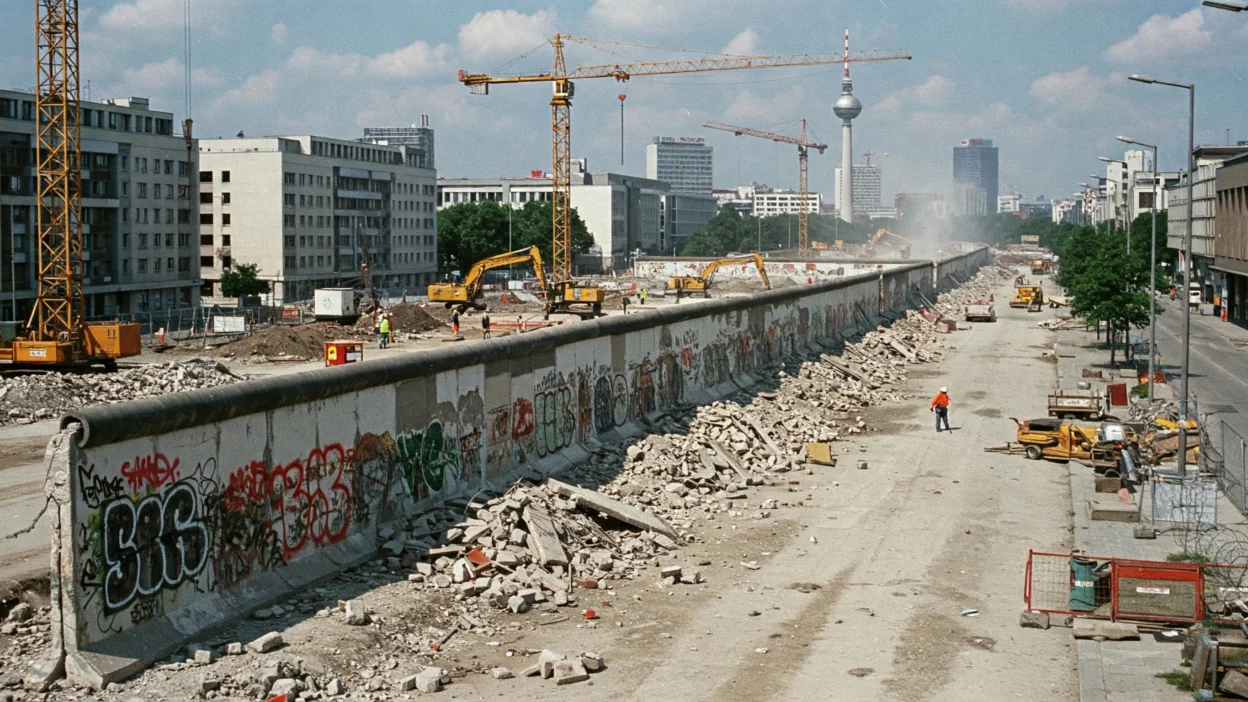
In the summer of 1994, I stood at the edge of the Berlin Wall, staring at the crumbling remnants of a structure that had, only a few years prior, divided a city and an entire world. My name is Martin Huber, and I was there, not as a tourist, but as someone who had spent the better part of my life on the wrong side of history.
I was born in East Berlin in 1965, under the oppressive shadow of the GDR—the German Democratic Republic—a regime that prided itself on control, surveillance, and secrecy. My father was a member of the Ministry for State Security, the infamous Stasi. It was not a choice, but a birthright, and like every other child of an officer, I was taught that loyalty to the state was above all else.
Yet, as a young man, I found myself questioning the very foundation of my existence. The government, with all its promises of equality, justice, and freedom, had done little to protect my family from its own hypocrisy. My father’s career was as much about hiding the truth as it was about enforcing it, and I began to see the dangerous cost of loyalty to a regime that cared little for the people it ruled over.
By the time I was eighteen, I had made a choice that would define the rest of my life: I became a spy for the West. It was not an easy decision, nor was it made lightly. The consequences of betrayal in the GDR were severe—disappearance, imprisonment, even death. But I had seen the darker side of the state up close, and I was ready to take the risk.
In the early 1980s, I found myself working as an informant for the CIA, smuggling critical intelligence across the Iron Curtain. The West thought of me as a hero—an East German defector helping them fight the regime from within—but for me, the stakes were much higher. It wasn’t just about espionage; it was about my survival.
I remember the first meeting with my CIA contact, Thomas, an unassuming man who spoke with an American accent that felt out of place in the shadowy corners of Berlin. “This is bigger than you, Martin,” he said. “You’re not just helping us bring down the wall—you’re fighting for a future you’ve never seen. And in doing so, you’re also fighting for your family’s freedom.”
But that was the problem, wasn’t it? My family. They were still entrenched in the system I was working against. My mother, who was too afraid to question anything. My father, who would have seen my betrayal as a personal affront. The very idea of them finding out terrified me, but I couldn’t allow my fear to govern my actions. The East German regime was a machine, and I had to be its dismantler from the inside.
My life became a constant balancing act. Every mission I undertook carried its own dangers, but the most treacherous element was never the task itself—it was the constant need to lie. Every moment I spent in Berlin, among my colleagues, friends, and family, I wore a mask. It was a life of paranoia, of questioning every interaction, every word. Who could I trust? Was this person an ally, or a potential enemy? My mind was constantly running through scenarios, calculating the risks of each conversation, every passing glance.
It was during one of these missions in 1986 that the cracks in my facade began to show. I had been tasked with infiltrating a Stasi meeting to gather information on a classified operation, but things went awry. The meeting was raided by the authorities, and I found myself in the crossfire, forced to flee into the streets of East Berlin. It was there that I came face-to-face with someone I had never expected to see again—my sister, Anna.
Anna had always been my protector, even when I was young. She was ten years older than I was, and had watched over me as a child, often protecting me from the harsh reality of our upbringing. But when she saw me running, covered in sweat and dirt, she didn’t ask questions. She grabbed me by the arm and pulled me into the nearest alley.
“Martin,” she whispered urgently. “What’s going on? Why are you running?”
I looked at her, my heart pounding. “I can’t explain it now. But I’m in danger. I need to go.”
She hesitated, then nodded, her eyes filled with sorrow. “I always knew you weren’t what they said you were. But this… this is too much.”
That moment changed everything. Anna’s loyalty was now torn between the brother she had always known and the state she had always served. She knew enough to see the truth, but speaking it aloud could cost us both our lives. I told her I had to leave, and she silently agreed. I would never see her again after that night.
For years, I operated as a ghost, passing through the tunnels of espionage, always moving forward, always hiding. And yet, with each passing year, the walls between myself and the world I once knew grew higher, until the day the Berlin Wall fell.
I had crossed back and forth between East and West Berlin countless times, but I had never felt the weight of the wall’s existence quite as intensely as I did that night in November 1989. I had been in a safe house, monitoring reports from the west when the news hit—people were climbing over the wall, breaking through the gates, demanding freedom. In a way, it felt like a personal victory, like the final piece of the puzzle had fallen into place. But even then, a part of me felt hollow. The truth that I had spent my entire life fighting for was now out there, exposed for the world to see.
But the consequences of truth—of freedom—were not as simple as I had once believed.
In the years that followed, I found myself in a new role, no longer a spy, but a man facing the aftermath of a war fought in shadows. I moved to London, where I was offered a job with an international security firm. I thought I could put the past behind me, but the ghosts of my former life continued to haunt me. I had exposed myself to so much risk, so many lies, that I wasn’t sure who I was anymore. I had betrayed my country, my family, and myself. Yet, as I sat in my apartment overlooking the Thames in 1994, I realized I could never truly escape my past.
I had helped bring down the Wall, but in doing so, I had shattered the delicate balance between loyalty and betrayal. The moral compromises I had made were not easily forgiven, even by myself. There was no easy redemption, no simple way to reconcile the choices I had made. And perhaps, in the end, that was the true cost of truth.
I spent my days writing, trying to make sense of the years I had lost. I found solace in penning my autobiography, a way to exorcise the demons that had followed me for so long. And in that process, I came to understand something about the human condition—that we are all products of the stories we tell ourselves. But as my life came full circle, I realized the most important truth was that freedom comes not from breaking down walls, but from the ability to live with the ones we have built around ourselves.
And so, in 1994, as I walked through the streets of Berlin once more—no longer divided, no longer a man in hiding—I knew that my journey was far from over. But the real question was no longer about who I had been, but who I could still become.


